
Before replacing your shoes, look at the heels, soles and stitching
A heel is wearing down. Before searching for a new pair, take a look around the shoes you already own. Repair might be an option if they still suit you.
Repair is not always cheaper overall, and not every shoe can be repaired. Is the problem limited to the sole, or are the upper and lining also damaged? Consider the quote together with what the repaired shoes could reasonably be used for.
Dương Trần Quốc fanhungry · Wikimedia Commons · CC0 · Unmodified

Look around the outside, then inside
In good light, check the heels, soles, uppers, stitching and lining. This is preparation for a useful conversation with a repairer, rather than a way to diagnose repairability yourself.
“The outer edge of the heel is worn,” “the sole is separating,” and “the lining rubs my foot” describe different problems. Note the place and symptom, and remember that the two shoes may differ.
Do not keep wearing slippery, unstable or seriously uncomfortable shoes merely to save money. Nor should you assume a separating sole will be safe after an improvised glue repair. Ask a suitable specialist about the condition. Being safe to wear comes before the price.
A manufacturer’s repair service is not a universal promise
REGAL’s official repair guidance explains that damage to the upper leather or the availability of parts can prevent a repair. Even where a manufacturer offers a service, the individual pair still matters. See REGAL’s repair information.
Those conditions concern its relevant products, not every brand or type of shoe. Check what the retailer, manufacturer or repair shop accepts. Mention any previous repair by another business.
A model number, material and approximate purchase date can help if you know them. Do not invent a date to fill a gap. Tell the repairer what you do not know and let them examine the actual shoes.
Include more than the repair charge
Suppose the repair costs JPY 3,300 including tax and shipping to the repairer and back costs JPY 1,100 in total. That totals JPY 4,400. If a possible replacement costs JPY 8,800 with no additional delivery charge, the immediate difference is JPY 4,400. These are hypothetical prices, not a real shop’s quote.
| Hypothetical option | Total for this decision |
|---|---|
| Repair JPY 3,300 plus shipping both ways JPY 1,100 in total | JPY 4,400 |
| New shoes JPY 8,800, no extra delivery charge | JPY 8,800 |
| Difference in payment | JPY 4,400 |
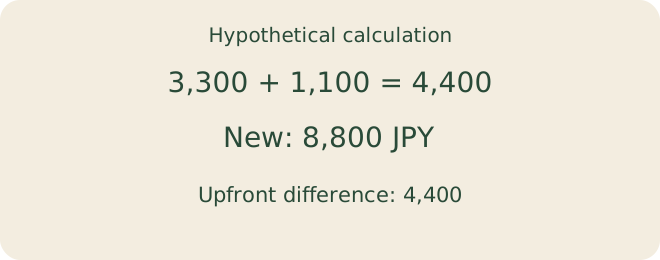
That difference alone does not prove repair is better value. The condition afterwards, remaining damage and suitability for the intended use may differ. Do not assign a convenient lifespan in years simply to make a cost calculation look attractive.
For an in-person visit, include travel and time. Consider what you will wear while the shoes are away. Ask whether a quotation itself costs money and how the shop will contact you if it discovers additional work.
The return date can matter as much as the price
If you need the shoes for work or an event, say when. Workload and parts can affect completion, so ask what the shop can actually commit to. A low-cost repair that misses the required date may lead to another purchase.
If you have another usable pair, you may have time to seek advice instead of buying immediately. Before purchasing more care equipment, think about the roles of the shoes already at home, such as commuting or wet-weather use.
New repair parts may also alter the appearance or feel. Ask about the likely result rather than assuming the shoes will become exactly as they were. Explain the aspects of comfort that matter to you.
A quote can still lead you back to replacement
Seeking advice does not mean you must approve the work. Understanding the required repair makes comparison with a new pair more concrete.
Replacement can be a sensible decision if repair is impractical, the shoes no longer suit their purpose or they cause discomfort. Alternatively, spending within a budget to keep a favourite pair usable can be a valid choice.
For the next purchase, look at care and repair support alongside the price. Thinking about how you will use that pair can leave you with a more useful decision than simply choosing the lowest ticket price.
Sources and assumptions
Official information checked November 5, 2026, Japan time. This article concerns repair decisions in Japan. All example prices and shipping charges are hypothetical Japanese-yen amounts, unrelated to the photographed shoes or a specific quotation. Confirm repairability, timing, price and finish with the actual repairer.