
Setsuyaku Life / Guides
Should you cancel a savings-type insurance policy? Review fees and separate saving from investing
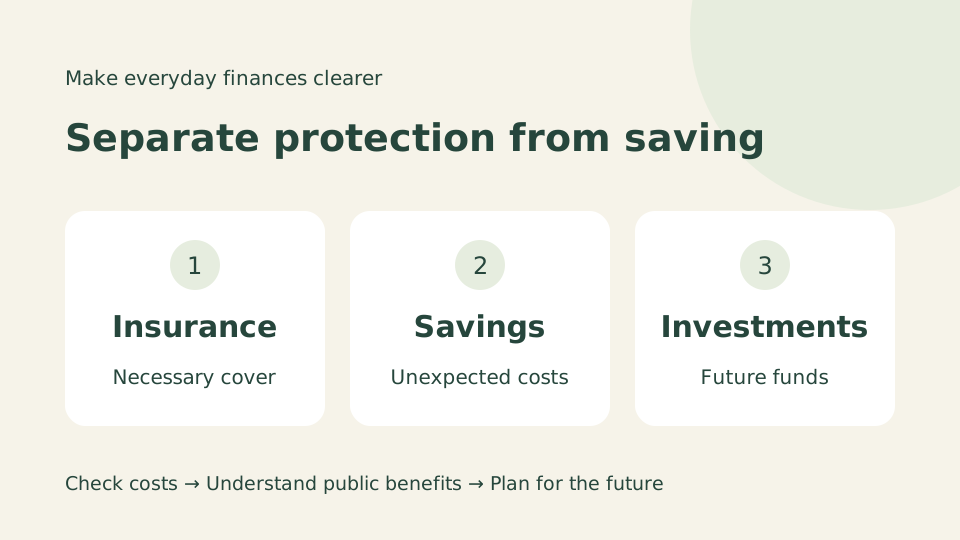
Fees in savings-type insurance, Japan’s high-cost medical expense benefit and possible uses for reduced premiums: three things to consider when reviewing insurance.
1. Some savings-type policies have high costs: separate insurance and investment
My reason for not recommending savings-type insurance is that some products have high fees and other costs.
Not all of a JPY 10,000 monthly premium goes into savings or investment. Some pays for cover, sales and contract administration.
Foreign-currency products may involve insurance costs, currency-conversion costs and surrender costs. The types and amounts vary by product. SMBC’s explanation of costs also describes several categories of charges.
For money intended to grow, the amount deducted in costs matters. Combining insurance and savings can make it harder to see how much pays for cover and how much goes into savings.
That is why I do not recommend taking out savings-type insurance specifically to build assets. I suggest using insurance for necessary protection and considering savings and investments separately.
However, the cost of protection is not all an administrative fee. Compare equivalent cover and terms when assessing costs.
Early surrender can return less than the premiums paid. Compare today’s surrender value, future premiums and future benefits. If replacing cover, confirm the new contract and coverage start first.
Some contracts may allow a change to paid-up insurance: stop premiums and reduce cover. The Japan Institute of Life Insurance’s explanation has further details.
2. Japan has a public system that limits eligible medical expenses
“What will medical care cost if I become ill?”
That uncertainty is one reason people buy insurance.
Japan’s public medical insurance includes the high-cost medical expense benefit.
For eligible insured treatment, this system reimburses the part of a calendar month’s out-of-pocket costs above a specified limit. Limits vary by age, income and other conditions.
Hospital meals, extra room charges and treatment outside insurance are excluded. See the Ministry of Health, Labour and Welfare’s guidance.
Private insurance may therefore not need to cover every part of your medical-expense preparation.
First understand public benefits, then consider savings and necessary insurance for gaps.
The high-cost medical expense benefit concerns medical bills. It does not fund family living costs after death, retirement or lost earnings during time off work; those need separate consideration.
| What you want to prepare for | Possible approach |
|---|---|
| Medical expenses | Check public medical insurance, then savings or private cover for gaps |
| Family living costs after death | Review public benefits and savings, then consider protection for any gap |
| Unexpected and near-term spending | Keep accessible deposits or savings |
| Future money not needed soon | Consider saving or investing with an understanding of risk |
3. Consider saving or investing money freed from premiums
If reviewing insurance reduces monthly payments, consider directing the difference to savings or investments.
For example, reducing premiums by JPY 10,000 a month while keeping needed cover would free JPY 120,000 a year. This is a hypothetical calculation.
First build accessible savings for unexpected costs, illness and money needed soon.
For money not needed in the near term, investing may be an option. However, investments can lose principal and are not guaranteed to grow.
| Monthly amount | One year | Ten years |
|---|---|---|
| JPY 5,000 | JPY 60,000 | JPY 600,000 |
| JPY 10,000 | JPY 120,000 | JPY 1,200,000 |
These are simple contribution calculations, not achieved premium reductions or investment results.
Use insurance for needed protection and savings or investments for future money. Separating their jobs can make finances clearer.
Final checklist
- Check contract documents for fees and other costs
- Compare surrender value with future premiums and benefits if kept
- Check public benefits and protection your household needs
- Prioritise saving the difference; consider investing only surplus funds
Official sources & references
SMBC: foreign-currency insurance features and costs (product-specific)Ministry of Health, Labour and Welfare: high-cost medical expense benefitMinistry of Health, Labour and Welfare: guidance and excluded expenses (PDF)Japan Institute of Life Insurance: when premium payments become difficultChecked October 25, 2026 (Japan time). Amounts and terms may change. Check current official terms before applying, buying or cancelling. This is not a personal-use report or specialist-reviewed content.